The eight checks, in the order I run them
Nobody honest can guarantee a supplier. "No guarantee" is not the same as "no protection", though. This is the method, step by step — and what each step is actually worth to you.
-
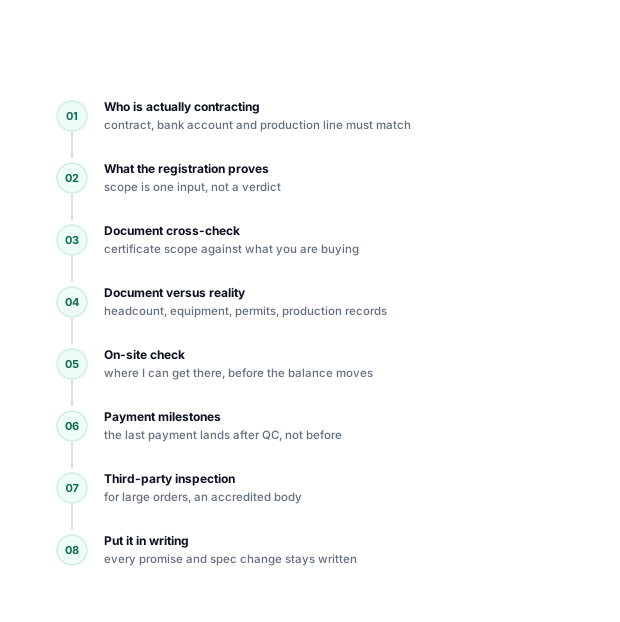
01Who is actually contracting
The three entities that must be the same company: the one that signs your contract and stamps it, the one whose bank account receives your deposit, and the one that runs the production line. I compare the registered Chinese legal name, the unified social credit code, the registered address and the company chop — and I report every place they disagree.
-
02What the registration does and does not prove
I read the registered address, the environmental permit, the equipment list and the employee social-insurance headcount — a company claiming to run its own lines with a single-digit headcount is not running lines. Business scope is one input, not a verdict: since China's 2021 registration reform, what is registered and what a company can do are two different things. A court has held that a bidder who added “manufacturing” to its scope on the day of the bid still had manufacturing capability.
-
03Document cross-check
Certificate numbers verified at the issuing body, not against a PDF someone emailed you. Test reports checked for sample name, date and standard. System certificates checked for validity and scope — a valid certificate for the wrong process is still the wrong certificate.
-
04Document versus reality
Is the material named in the test report the material they are quoting you? Are the claimed processes covered by the certificates they hold? This is where most of the surprises get caught — before any money moves.
-
05On-site check, where I can get there
Production floor, incoming material area, whether the machines are actually running, inspection room, calibration labels, batch records, finished goods warehouse. I am based in Guangdong and can travel across the Pearl River Delta.
-
06Payment milestones
Deposit against the proforma invoice; balance tied to QC passing. No pass, no balance. This single term is the most useful thing I can put into your order — and many buyers do not know it is negotiable. It usually is.
-
07Bring in a third party for big orders
For larger runs I will tell you plainly when to spend your money on a formal inspection by an accredited firm instead of relying on me. Saying that costs me the job sometimes. Saying anything else would cost you the order.
-
08Put it in writing
Every quotation, promise and specification change stays in writing — so "that is what we agreed" is never a debate three months later. I write spec sheets, technical standards and quality agreements in English and Chinese.
Two limits I want to be explicit about
- Any remote check has limits. I can confirm documents and public records. I cannot see inside a production run from a desk.
- I am not a certification body, a testing lab, or a lawyer. I find gaps; I do not issue certificates or give legal opinions.
If someone tells you they can guarantee a supplier 100% from behind a desk, that is a sales line, not a professional answer.
Timeline
How long this actually takes
Typical sourcing timeline for packaging. It depends on your product — and the two stages buyers most often underestimate are sampling and shipping.
| Stage | Typical time | What is happening |
|---|---|---|
| Requirement clarification | 1–2 days | Your spec, target market, quantity and target price. This drives everything else, including compliance. |
| Supplier search & shortlist | 3–10 days | Chinese-language platforms and Guangdong manufacturer networks, screened for real manufacturers. |
| Verification & quotation comparison | 2–5 days | The eight checks above, plus price, MOQ, lead time, tooling and payment terms side by side. |
| Sampling & confirmation | 2–8 weeks | First samples rarely pass on the first round. Plan for at least one revision. |
| Production | 4–12 weeks | Driven by material lead time, tooling and the factory's real capacity — not the schedule they quote you. |
| QC & shipping | 2–8 weeks | Pre-shipment check against your spec, then freight. Shipping is not instant, and neither is a rework. |
Fixed-price reports are delivered in 3–5 business days from payment, depending on the report.
Roles
Who does what in an order
So there is no confusion later about where my job stops.
What I do
- Verify the supplier before payment
- Negotiate price, MOQ, lead time and payment terms — in Chinese
- Write the spec, quality agreement and acceptance criteria
- Check the sample and the mass production against your spec
- Reject a bad batch and push the rework
- Keep every promise and spec change in writing
What is not my job
- Paying the factory — you pay them directly
- Holding your deposit or balance
- Issuing certificates or lab test reports — those come from accredited third parties
- Booking freight and clearing customs
- Legal advice on your supply contract
- Guaranteeing a supplier's future performance
Step one
Step one is free.
Send me one company name. I will tell you what I can see from here and whether anything in it is worth paying me to dig into.
Why step 6 matters most
Deposit against the proforma invoice, balance tied to QC passing. It costs you nothing to ask for, and it puts the last payment behind the last inspection.
No pass, no balance.